
The Inevitable Convergence of Two Worldchanging Technologies
“Roses are red, violets are blue,
Bitcoin and AI may help us renew,
As innovation and efficiency accrue,
A better world could emerge from the two.”
- ChatGPT, optimistically
“Roses are red, violets are blue,
Bitcoin and AI may break what we once knew,
As algorithms govern what we do and pursue,
Our humanity may fade, and our freedoms too.”
- ChatGPT, pessimistically
Bitcoin and new artificial intelligence (“AI”) applications are both on course to drive a new wave of productivity and efficiency gains for humanity. While more people each day are beginning to appreciate the independent potential of each of these technologies to positively reshape the world (bitcoin: cure the ills of money printing, seigniorage, and financial censorship; AI: unlock significant productive and creative output potential), we believe additional excitement is warranted for the coming intersection of bitcoin and AI. AI will be a powerful force to open up new design spaces and opportunities for bitcoin infrastructure and commodify bitcoin by making it more accessible, supporting the Ten31 thesis that bitcoin’s utility and applications will expand over time and that the TAM for bitcoin infrastructure is far bigger than most realize. In addition, bitcoin will naturally complement the growth of AI, both serving as a payments tool for computational demands and asserting its scarcity to impose real world costs and constraints on any tendency for AI algorithms and AI produced content to replicate to infinity.
Introduction
Those paying attention have noticed the explosion of new generative AI applications over the last year. Suddenly, social media feeds seem to be flooded with exquisitely rendered art generated with a keystroke or screenshots of natural conversations with digital assistants demonstrating encyclopedic knowledge and better grammar and manners than most real humans. It seems clear that we are witnessing the early stages of a paradigm shift in the human-computer relationship that will affect every aspect of the way we learn, work, create, and communicate. While there’s undoubtedly a nontrivial amount of noise amid the growing AI hype, we see mounting evidence that this technology and its applications will drive unprecedented improvements in productivity, individual empowerment, and knowledge acquisition that could provide a generational opportunity to those adopting these tools (and also pose an existential threat to those that do not, including the world’s most dominant businesses and institutions).
To bitcoin enthusiasts, these lofty references to a zero-to-one technical innovation with the potential to transform legacy systems and uplift individual creativity with global implications probably sound very similar to bitcoin itself. As we’ve done our best at Ten31 to drink from the AI firehose over the last year, it has struck us that few recently have sought to explore AI’s many parallels to bitcoin and the potential convergence of these two technologies. Neither bitcoin nor AI have yet managed to pierce the veil of truly mainstream awareness or adoption, but we believe both are on a path to becoming foundational pillars of 21st century society and will become progressively more intertwined and symbiotic over the coming decades.
At Ten31, our key conviction is that every company will eventually become a “bitcoin company” in some way (just as every company is now effectively an “internet company”), and we increasingly believe the same is true for AI: no company interested in survival will be able to ignore absolutely scarce, programmable, internet-native money (bitcoin) or technology that yields 1,000x productivity gains (generative AI), and those two forces will synergistically shape the coming decades in ways few have yet imagined.
As with bitcoin, the early adopters of AI tools and technologies will have the opportunity to benefit disproportionately relative to those that come later. Every company should have a bitcoin strategy, and similarly every company (including bitcoin companies) should have an AI strategy – and if you don’t have either of those now, you are already falling behind…
A Brief History and Overview of AI and Recent Developments
People have been writing about the coming era of AI and the philosophical, moral and existential implications for a long time (e.g. I Robot, 1950; The Moon is a Harsh Mistress, 1966; 2001: A Space Odyssey, 1968). You can even trace related concerns back to Frankenstein (1818), which told the classic story of a scientist who creates a monster and then loses control over it, highlighting the potential consequences of creating something beyond our ability to manage. In these stories, there have clearly been warnings of the unintended consequences and ethical dilemmas as the line blurs between human and robot. Recent interactions with AIs have raised similar concerns – while we can’t address all possible scenarios, we explore below some reasons for optimism about the role that bitcoin could play in mitigating some potential dystopian outcomes.
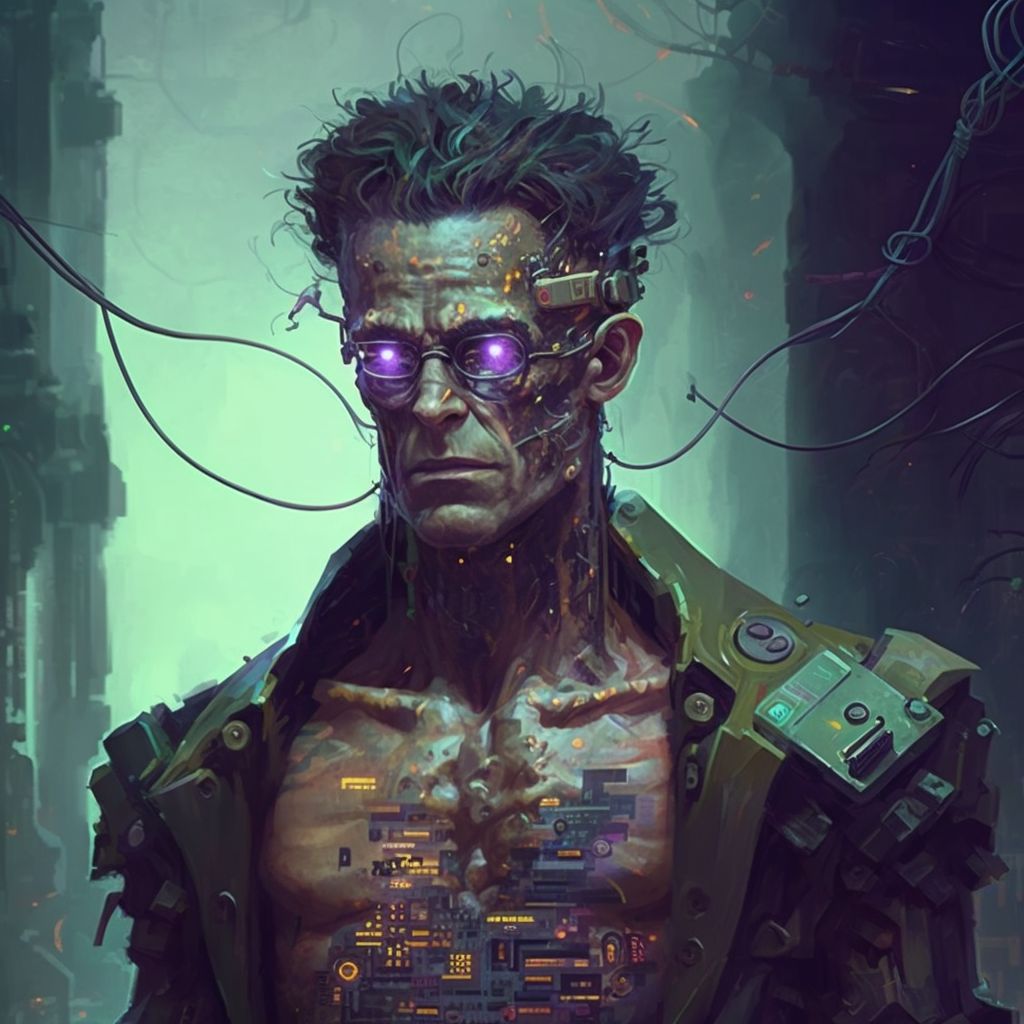
AI-powered Frankenstein controlling the digital panopticon
Artificial intelligence generally refers to the idea of machines performing tasks that typically require human intelligence. Machine Learning (ML) is a subset of AI that enables machines to learn and improve from experience without being explicitly programmed; instead, machine learning algorithms are trained on large amounts of data to recognize patterns and use those patterns to make predictions or decisions.
Early AI research focused on symbolic reasoning and rule-based systems, but progress was slow due to limitations in computing power and lack of data. In the back half of the 20th century, the development of neural networks and other machine learning techniques led to renewed interest in AI, but advances in big data, cloud computing, and processing power over the last decade were what finally enabled breakthroughs in areas such as computer vision and natural language processing, among other fields.
Most notably, in 2017 Google AI researchers introduced “transformers”, which are a type of neural network architecture that can process and analyze large amounts of data, such as text, images, or sound. Transformers work by breaking down the data into small parts and processing each part simultaneously, allowing them to identify patterns and relationships within the data. Transformers can be used for a variety of tasks, such as language translation, image recognition, and speech processing.
Large Language Models (LLMs) are an application of transformer architecture specifically designed for language tasks such as language generation and understanding, and are often pre-trained on large amounts of text data using unsupervised learning techniques (e.g. the algorithm may be trained by digesting the entire internet). The transformer architecture allows the models to process language by looking at it as a whole, rather than one word at a time in order, enabling the algorithm to understand the context of each word and how it relates to the sentence as a whole, ultimately resulting in the ability to both understand and generate human-like language.
There have been several transformer- and LLM-based generative AI applications that have recently seen exponential adoption and generated tremendous excitement for the capabilities they may unlock:
-
Image generation : deep learning models are trained with a large dataset of images which are used to generate new images from scratch. In some cases, these models can be combined with LLMs to allow image generation with text prompting. Some of the more common deployments include DALL-E, Midjourney, and Stable Diffusion. Tools like this have been estimated to reduce the cost and time of a graphic design from $150 and 5 hours to pennies and seconds. We note all of the images in this essay were generated with AI.
-
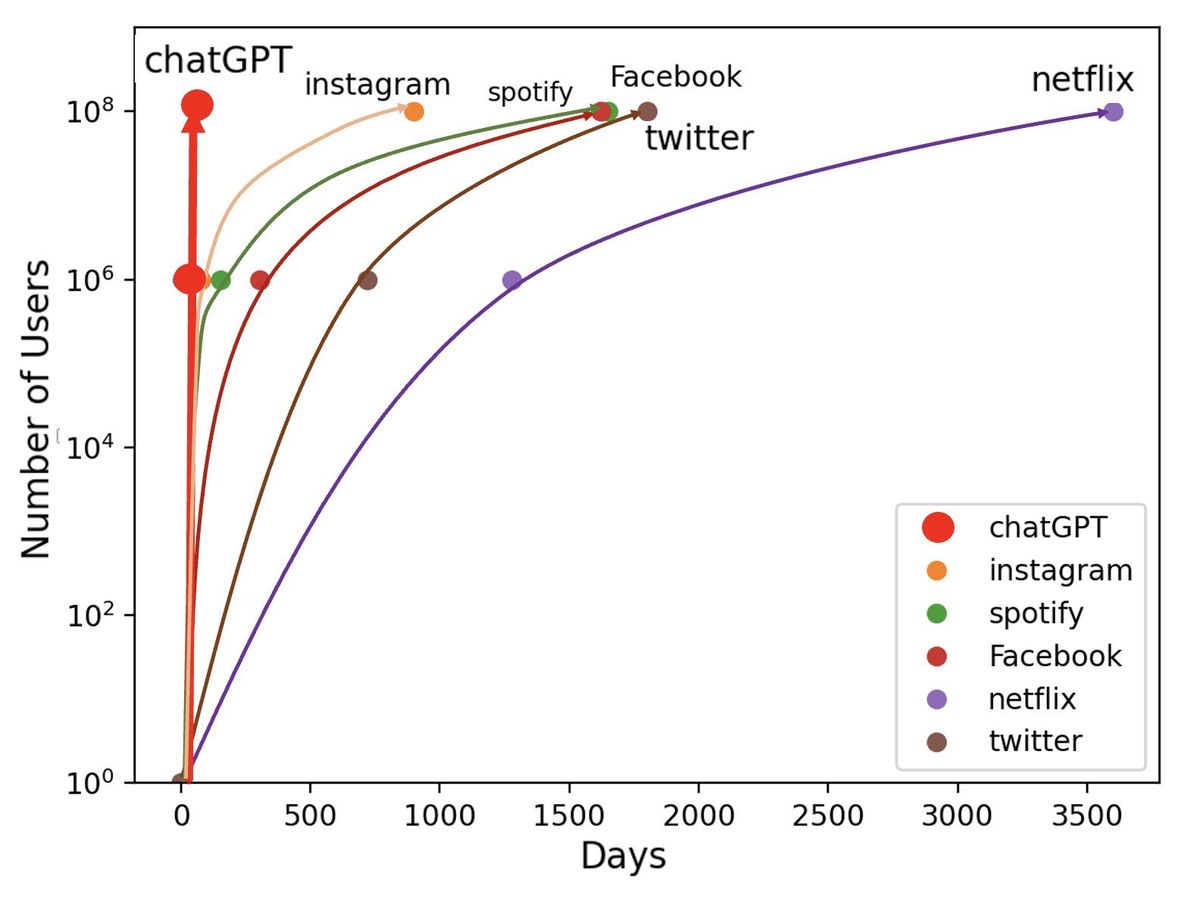
Text generation : GPT-3 (Generative Pre-trained Transformer 3) is a language model introduced in 2020 and developed by OpenAI, using 175 billion parameters (learnable elements or weights of the model). It is the successor to GPT-1 (2018, 117 million parameters) and GPT-2 (2019, 1.5 billion parameters) and has demonstrated impressive language generation capabilities, including the ability to generate coherent paragraphs of text, answer questions, and even write code (discussed below). This type of model is pre-trained with a significant amount of unlabeled data (self-supervised learning), and then can be fine tuned by adjusting the model’s parameters for the specific task or by other training techniques. The most explosive use of this technology thus far has been the launch of ChatGPT , which is an AI-based digital assistant designed to respond to questions by generating human-like text, and has instantly become the fastest growing consumer application in history, reaching 100 million users after having been launched only 10 weeks ago. While ChatGPT and other generative AI applications are not perfect (and are already raising important questions about bias, censorship, dependence, and copyright, among others), it is clear we have crossed a chasm, and as a result there will now be a clear distinction between the pre- and post- GPT eras.
-
Code generation : given code exists simply as text applied under various programming languages, LLMs have been extended into the realm of code generation. Two such examples are GitHub’s Copilot and Replit’s Ghostwriter . GitHub Copilot (owned by Microsoft, a major OpenAI investor ) is an AI system developed by OpenAI in collaboration with Github, designed to provide software creators with AI-assisted code completion suggestions (i.e. autocomplete), and can also suggest code snippets based on natural language descriptions provided by the user. Copilot is powered by OpenAI’s Codex system and trained on a large corpus of open-source code available on GitHub. Impressively, Github boasts a reported 55% increased speed in coding for software creators using Copilot (with Copilot generating 46% of code written), a dramatic improvement in productivity . Similar to Copilot, Replit’s Ghostwriter provides AI-powered code completion and natural language-prompted code generation like Copilot, but also provides additional features such as code transformation (e.g. refactoring code to make it faster or translating to another language) and code explanation in natural language.
Implications of New Generative AI Tools
It would be an understatement to say the new applications above represent a step change in productivity and output potential for individuals and businesses alike. What will now be possible leveraging these tools would have been unimaginable a few years ago, and the primary limiting factor will only be human creativity, with the underlying technology expected to continue improving significantly over the near- and medium-term (e.g. GPT-4 is speculated to contain 100 trillion parameters, a ~600x increase from GPT-3).
With regards to software development, we believe these new AI-assisted coding tools will be one of the fundamental unlocks of productivity and output of the coming years. We have previously written about the importance and impact of open source software; one of the many powers of open source is being able to leverage the work of others, rather than build from scratch. There are very clear comparisons between AI tools and open source in this way, where huge efficiency gains are possible (e.g. now you can “install” 100 hours of work with AI instead of doing it yourself, just like you would have done using existing open source software).
We can imagine many implications of the continued adoption of these new tools (some good, some concerning), including but certainly not limited to the below:
-
The rise of the 1000x developer. The very best software creators with the capabilities and willingness to embrace these tools can leverage AI assistants to compound their output, with a single person doing the work of hundreds or thousands.
-
Companies will be able to get more done with less. A company may only need a few of the most prolific creators, augmented by a small group of lower level developers also utilizing these tools. Small teams can scale while remaining nimble.
-
The landscape for software creators will become more open and inclusive. People who did not know how to program previously will now have the toolkit and capabilities to become engineers, thereby increasing the number of developers by an order of magnitude in the next decade. This should also help alleviate the bottleneck of bitcoin and lightning developers over time.
-
Powerful centralized actors (whether nation states or large conglomerates) may look to abuse this tech for their benefit. There are significant concerns that abuses of this tech could be a significant setback for civilization, creating a dystopia and digital panopticon, as well as the previously noted tail risks of hostile/adversarial AIs.
-
The value of proprietary data and compute power will increase. Large, unique data sets used for training AI will become more valuable. Those that have this data could elect to monetize it in a more significant way, or leverage it for training their own proprietary algorithms. This will also highlight the importance of owning your own data and infrastructure to counteract potential centralization risk. Within the bitcoin ecosystem, we could see how data and analytics companies like Mempool.space could be potential beneficiaries in this regard, as well as lightning infrastructure companies like Strike.
No matter the potential negative consequences of these technologies, the genie is out of the bottle; the potential benefits have too much upside for these tools to be ignored or stopped.

The 1000x software creator overseeing an army of AI assistants from a penthouse apartment
The Likely Synergy Between Bitcoin and AI
Whether the long-term net result of AI will look more like C-3PO or HAL-9000 is beyond the scope of what any of us can predict today, but use cases that combine AI with bitcoin applications could help channel this emerging technology to accelerate bitcoin adoption and make it more accessible. What’s more, the pairing of these two technologies will likely emerge organically due to the many complementary characteristics they share:
-
Universally relevant: Bitcoin and AI will both become foundational underpinnings of human coordination and productive output and are poised to have an impact on individuals and businesses around the world to a degree that rivals electricity and the internet.
-
Purely data: Both bitcoin and AI are native to and only conceivable in the realm of information. The shared reality of bitcoin is captured entirely by the information on its blockchain (“ the map is the territory ”), in fundamental contrast to most “blockchain technology” projects. Likewise, generative AI LLMs were trained on a corpus of computer-readable data, and the resulting outputs are essentially interactive, iterative exchanges of yet more data. This fundamental trait makes bitcoin and AI natural bedfellows for new applications (described further below).
-
Computationally intensive: A fundamental, non-negotiable component of bitcoin’s architecture is its Proof of Work, which requires miners to expend energy and perform significant computation to successfully append a new block to bitcoin’s blockchain. The self-attention mechanism of generative AI similarly relies on parallel processing performed by graphics processing units (GPUs), which impose a real-world cost on the system. While this cost will likely decline precipitously with further advancements in parallel processing, AI will remain tethered to the constraints of the physical world just as bitcoin is (though the simplicity and asymmetry of bitcoin’s Proof of Work makes it a superior source of truth ).
-
Flexibly programmable: Bitcoin and generative AI both offer engineers and creative entrepreneurs powerful primitives on which to build a vast array of complex applications. Bitcoin’s simple design and sound monetary policy minimize attack vectors and align incentives to allow incremental functionality to be layered on top of a durable, robust foundation – such extended functionality includes bespoke transaction scripting, second layers like the lightning network, privacy tools like collaborative transactions, and smart contracts. While the latest AI models are significantly more complex than bitcoin, the volume and diversity of projects developers have already built in the early innings of generative AI, as well as the proliferation of open source models (CodeGen, Stable Diffusion) and frameworks (PyTorch, TensorFlow), are evidence of this technology’s programmability and versatility.
-
Deeply researched: While both technologies are groundbreaking innovations, neither emerged from scratch. Bitcoin is built on decades of prior research and leaps in cryptography applications, including b-money , Hashcash , Merkle Trees , and DigiCash , while modern generative AI stands on the shoulders of early rule-based systems and neural networks. Both technologies are closer to the Model T than the horse and buggy and thus closer to being ready for primetime.
-
Inherently deflationary: Perhaps the most crucial shared feature is the technologies’ tendency to support deflation, or the natural decline in prices resulting from a progressively more productive base of technological and human capital over time. In allowing for potential step-function improvements in human productivity like pivotal technologies before it, generative AI has the potential to enable the production of both more and better goods and services for the same or less input, putting downward pressure on prices to end users and turning luxuries into necessities . Meanwhile, bitcoin’s absolutely finite money supply will allow for the benefits of that exploding productivity to accrue to savers, as the purchasing power of bitcoin’s fixed supply balloons against an expanding basket of goods and services. Progressively more people will gravitate toward using productivity-enhancing AI tools and saving / transacting in productivity-preserving bitcoin, finally allowing the inherently deflationary nature of free markets to fully shine through – a boon for human flourishing, contrary to mainstream dogma.

The earliest image on record of a bitcoin supercomputer on an AI-powered Model T

The latest update of the Model T, leveraging AI transformer version BTC-2140
Thanks to all these shared traits, we expect a powerful symbiosis will form: bitcoin will help support new AI applications, and new AI applications will extend the utility of bitcoin. A couple notable examples of this dynamic are already evident in the Ten31 portfolio.
Ten31’s Early Entry into Bitcoin-Oriented AI Applications
Ten31 has invested in two companies to date that are relevant to emerging AI trends, Stakwork and StatMuse.
Stakwork
Stakwork is a cloudsourcing platform that combines the power of humans and AI. Stakwork empowers a globally distributed ecosystem of workers, predominantly in emerging markets and Global South countries, who can opt in to automated microtasks driven by algorithmic tools designed to aggregate the completion of complex, repetitive work on behalf of customers who outsource work to Stakwork. Stakwork’s services range from data annotation to image and video processing, which pair AI-based processing with human oversight as appropriate. The human input from these microtasks feeds into a Reinforcement Learning from Human Feedback (RLHF) mechanism for various machine learning models and toolkits (including Stable Diffusion, OpenAI’s Davinci, and more), helping to train these tools and expand the scope of what’s possible with automation. Anyone can opt in to complete Stakwork’s tasks and can be paid in bitcoin over the lightning network without needing a bank account or even an email address; all that is needed is a mobile phone and connection to the internet. In effect, Stakwork trades digital scarcity (bitcoin) for human scarcity (time), and founder Paul Itoi likes to refer to the potential of this globally available decentralized workforce as a world computer or global brain .
StatMuse
Like Stakwork, StatMuse also has a theme tied back to the human scarcity of time. StatMuse is an AI search and knowledge platform that aims to save time by providing users access to data and intelligence using natural language processing. Leveraging proprietary natural language understanding & generation technology, StatMuse has developed the leading AI platform for discovering and generating sports information and content, and now is expanding into money and bitcoin. StatMuse has been ahead of the curve on conversational search (that is, queries based on natural language, rather than keyword-based search), and since the introduction of transformers, this has clearly been the direction the puck is going for search, knowledge and content creation. We expect human interaction with computers will be increasingly facilitated through natural language, and given the recent developments in AI it is not hard to imagine a future where consumers, creators, and businesses are supported by digital assistants providing personalized knowledge, support and infinite creative leverage to improve productivity and save time (a concept that was described in The Sovereign Individual in 1997).
StatMuse has deep domain expertise and unmatched data in sports, which is an important influence of culture and where the real-time nature of data is critical. Its expansion into bitcoin will allow StatMuse to serve the most passionate sports fans and bitcoiners directly on its platform worldwide. Money is naturally intertwined with the world of sports, and there is no larger or more important category than money itself, making a sports+money combined platform that much more powerful. StatMuse is also one of the earliest examples of a theme we expect to be more prominent going forward, which is traditional tech companies expanding into bitcoin, becoming bitcoin companies in their own fashion, and gravitating towards thinking in terms of and operating on a bitcoin standard in a world powered by AI.
The Future of the Bitcoin / AI Symbiosis
Both StatMuse and Stakwork are at the vanguard of what we expect to be an oncoming wave of companies leveraging both bitcoin and AI. While we can’t precisely predict every permutation of this megatrend, just a few more potential applications we’re excited about include:
Lightning Applications: The lightning network, bitcoin’s most widespread second layer, offers nearly instant and low cost transactions to dramatically extend bitcoin’s utility for daily, lower-value payments; however, despite significant recent improvements, it still suffers from early-stage UX headaches such as failed payments and the need for active channel management (either by end users themselves or trusted third parties, which present their own vulnerabilities and risks). AI applications for lightning could offer the potential for:
-
Improved routing and pathfinding for higher payment success rates and optimal fees. For example, we imagine massive historical transaction data sets could be fed into action transformer models to pave the way for much better lightning transaction reliability and lower fees, while abstracting the underlying routing logic from senders and receivers, further supporting lightning’s adoption as a mass market payments network.
-
Automated channel and liquidity management. A key burden shouldered by large routing nodes (and one of the major hurdles for fully self-sovereign use of lightning) is the need to open, close, and rebalance liquidity within payment channels. Blockstream has introduced the ability to automate elements of this multifaceted process with its recently launched CLBOSS system. We expect there will be opportunities for AI applications to perform similar functions by leveraging transaction data sets to help both routing nodes and regular users automatically manage channels and liquidity according to an increasingly granular set of criteria.
-
Privacy improvements. lightning payments can provide some natural privacy benefits relative to on-chain bitcoin transactions, but can still expose users to various privacy vulnerabilities . While clearly there could be concerns that increased use of AI by surveillance companies could infringe upon user privacy, we also speculate that AI tooling and applications could automate privacy best practices and bridge the UX gap that often confronts less technical users even when they understand the importance of privacy, especially as more of these tools are open sourced and can run on local machines (e.g. like Stable Diffusion is with image generation).
Taken together, these automation improvements (alongside ongoing breakneck development in the lightning ecosystem more generally) could be the unlock to make non-custodial, sovereign use of lightning more accessible in the coming years.
Mining Optimization: Innovators like Braiins have already shown early advances in providing special firmware intended to “autotune” bitcoin mining ASICs to automatically optimize for hashrate or power efficiency depending on user specifications. We could envision such solutions taking another leap with transformer-empowered systems dynamically and independently determining when and how much to over- or under-clock, and when to turn on or off based on machine efficiency characteristics, hashprice, power cost, and a host of other factors. Bitcoin mining shares many characteristics with classic commodities businesses where positioning on the cost curve and marginal efficiency gains differentiate winners from losers, so even fringe improvements to operations powered by AI could have meaningful implications for the industry.
Micropayments for Compute: As discussed, generative AI applications like ChatGPT depend on costly GPU processing to return results for user queries. While these costs should decline over time and AI infrastructure providers will undoubtedly experiment with a variety of revenue models, we believe bitcoin offers a unique potential solution for sustainably monetizing these services in the form of bitcoin micropayments over lightning.
The enabling of digital bearer micropayments with bitcoin over lightning (which are fundamentally unlike the credit-based transactions that have historically defined online commerce) could be highly relevant as search and knowledge acquisition platforms confront potentially seismic changes in the way queries are monetized. To the extent that generative AI’s ability to provide answers more quickly or directly short-circuits the typical user flow that supports the traditional “Cost Per Click” search advertising model, per-query lightning micropayments could offer an alternative for knowledge platforms to build businesses on top of generative AI search tools, in this case focused on the long tail of individual user demands rather than a monetization of users’ attention.
We’ve already seen the lightning micropayments use case start to blossom on Stakwork, “value for value” apps like Fountain and WavLake, AI image generators that exchange art for sats, and “zaps” on Nostr. The LSAT protocol * has also provided an interesting proof of concept for metered access to compute based on lightning payments. We could envision similar lightning integrations into AI tools like Replit’s Ghostwriter or Github’s Copilot to enable users to pay sats for those programs on a per-use basis.
Finally, given that bitcoin mining involves expending computing power in exchange for bitcoin, it seems intuitive to us that bitcoin should naturally be used in exchange for AI computing power (i.e. bitcoin becomes the unit of account for computing power).
The Bitcoin + Nostr + AI Stack: Those following bitcoin, distributed technology, or social media have noticed the recent parabolic growth of Nostr, a simple protocol to facilitate robust censorship resistant communication and information-sharing. With no marketing budget or support from a centralized entity, the number of Nostr profiles producing content has ballooned to over 2.5 million in just under two months. Bitcoin has clear synergistic potential with Nostr – several clients have already integrated native lightning payments – but we also believe AI could have a notable role to play. A few potential integrations we believe could drive value and form the early beginnings of a Bitcoin + Nostr + AI “tech stack of the future” are:
-
Censorship-resistant search and knowledge acquisition. Chatbots or digital assistants leveraging the natural language processing abilities enabled by transformer models and the open nature of Nostr relays could transmit sensitive or censored information in exchange for sats. A model like this might allow populations living under restrictive regimes (or just users dissatisfied with the curated information presented by traditional search functions) to query ChatGPT-like knowledge platforms built without restrictions or biases imposed by governments or corporations, and to receive that information through permissionless relays that are easy to spin up and difficult to fully eradicate. Compute costs for generative AI knowledge platforms still need to come down significantly for this model to scale, but we speculate that all the pieces are in place: AI could provide the content, relays provide the transmission, and bitcoin provides the monetization.
-
Discovery mechanisms. Transformer models could be used to periodically digest the corpus of all Nostr notes, after which competing clients could integrate the resulting AI tools to offer end users finely customizable content filters and deeply-informed suggestions for new npubs to follow. An even more interesting iteration of this concept would be one that used sats as the signal for discovery – for example, surfacing new accounts to follow based on the social graph of npubs your account has frequently zapped, or potentially interesting content and accounts based on contextual understanding (not just keyword matching) of posts you’ve zapped. Additionally, there will likely be a need for search tools that can dynamically filter through spam at the client and / or relay levels and better tools for discovery of niche relays, both of which could benefit from lightning-monetized AI capable of understanding and evaluating context. We could envision a variety of other ways that zap-guided AI could help rebuild content discovery for a decentralized paradigm where attention has to be organically earned rather than gamed by a few corporate employees to drive outrage or clicks.

The world’s first self sovereign Bitcoin + personal AI + Nostr supercomputer

The nation-state AI-enhanced surveillance machine
Rogue AI – Bitcoin Fixes This?
Despite all the productive applications we can envision from bitcoin, AI, and the synergy between the two, we acknowledge that technologists and developers have long worried about the many potential downsides of progressively advanced artificial intelligence. In particular, the concept of a highly advanced AI “going rogue,” self-replicating, and causing some kind of doomsday scenario has received particular scrutiny in recent years given the pace of machine learning advancements we’ve discussed. This is indeed a frightening future to imagine, but as in most other areas of life, bitcoin offers some reasons for optimism.
An AI’s ability to produce complex content in seconds is reminiscent of a central bank’s ability to trivially expand the money supply or a “crypto” developer’s ability to spin up a new altcoin at will – all seem to trend toward an infinite supply with few or no constraints. Ten31 has discussed elsewhere how bitcoin will fix the last two themes, but to the extent that some version of what we’ve discussed in this piece plays out, bitcoin could also become the ultimate constraint on the infinite replication of AI as well. As AI applications improve bitcoin’s UX substantially, they are likely to accelerate its pace of adoption, bringing it closer to becoming the global money of choice and thus progressively more necessary to pay for the (still very expensive) compute underpinning generative AI technologies. This trend will be further reinforced by the digitally native and instantly settled properties that make bitcoin ideally suited for this role. As this virtuous cycle progresses and the two technologies become more intertwined, bitcoin will begin to impose an unforgeable cost on compute power: unlike the fiat money paying for most generative AI today, bitcoin can’t be printed or manipulated, so any use of real-world resources (electricity, GPUs) to power generative AI will first need to either directly or indirectly perform Proof of Work to finance itself. No sats, no compute. In the age of digital infinity, bitcoin’s absolute scarcity will be king.
Conclusions
-
Bitcoin and AI are world changing technologies to which all individuals and companies will be forced to adapt. Just as every company will become a bitcoin company (using or integrating bitcoin in some way), every company will also become an AI company. It is inevitable these two fields will eventually overlap.
-
The dramatic upside offered by utilizing new AI technology will drive exponential adoption of these tools, even if these technologies also raise concerns of potential negative consequences. We expect an order of magnitude increase in productivity, as well as significant growth benefits to those who leverage generative AI technology.
-
Bitcoin and AI are complementary and synergistic partners. Bitcoin will help support new AI applications as a payments tool, and new AI applications will extend the utility and accessibility of bitcoin. In this way, AI could be a Trojan Horse for accelerated bitcoin adoption and development, with AI-enabled apps and features bringing in new waves of users and software creators to bitcoin.
-
AI has the potential to offer significant UX improvements to the bitcoin / lightning stack, which could provide an unlock to help bitcoin achieve escape velocity among mainstream users. By providing better automation and abstraction, AI-powered tools could drive vast upgrades in user flow to make using bitcoin a 10x+ better experience than legacy systems while enabling entirely new use cases.
-
As the diversity of AI applications proliferate, bitcoin will also be a tool to counteract any centralizing forces which may attempt to abuse the power of AI. The freedom to leverage the capabilities of an AI-algorithm will depend on the ability to pay for its computation with a politically neutral form of money resistant to censorship and debasement, and bitcoin is the only form of money which fits that bill. “If you can’t control the money, you can’t control the algorithm.” In addition, bitcoin may also provide protection from the risk of an AI self-replicating or AI content being produced ad infinitum.
-
The development of new use cases leveraging these tools supports Ten31’s fundamental thesis that the total addressable market of bitcoin infrastructure is much larger than most realize, and new verticals and applications will continue to emerge over time. There are parallel platform shifts happening as a result of both bitcoin and generative AI, and the benefits of such a change generally accrue disproportionately to those who participate and/or invest the earliest. As such, individuals and businesses utilizing the tools now will be advantaged versus those who aren’t, and capital allocators who are investing in bitcoin infrastructure tied to these priorities in anticipation of the AI-driven tailwinds will be afforded the most asymmetric upside.
*Several months following the publication of this piece, this protocol was rebranded as the L402 protocol.
**We want to thank the following people for providing input and influencing our thinking on these topics: Paul Itoi, Elaine Ou, and anonymous.